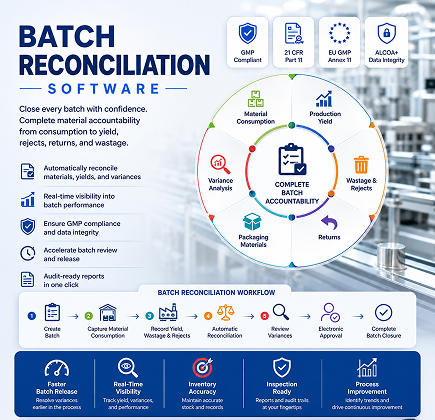
What is Batch Reconciliation Software?
Batch Reconciliation Software is a pharmaceutical manufacturing application that automatically compares planned material quantities against actual consumption, yield, rejects, returns, and wastage —flagging batches with unresolved accountability variances before final batch release. It replaces the spreadsheet a QA reviewer would otherwise rebuild by hand for every batch, line by line.
Veritas GxP's version of this is built to sit inside your existing batch record, not beside it. It pulls dispensing, production, and packaging data directly from Electronic Batch Manufacturing Records (eBMR) as it's generated, so reconciliation happens continuously rather than as a separate end-of-batch task — and every figure carries the same audit trail electronic-signature required under 21 CFR Part 11, EU GMP Annex 11, and ALCOA+.
What breaks in manual, spreadsheet-based reconciliation
What the system actually does, batch by batch
Automated Material Reconciliation
Every planned-vs-actual comparison across the batch runs automatically as data is entered — no end-of-batch spreadsheet rebuild.
Yield Reconciliation
Theoretical, expected, and actual yield are compared in real time, helping teams identify recurring yield trends earlier in the manufacturing lifecycle.
Packaging Material Reconciliation
Labels, cartons, bottles, blister packs, caps, and inserts are reconciled in the same workflow as manufacturing materials — no separate packaging spreadsheet.
Variance Analysis
Every variance is calculated against a configurable tolerance limit, so only genuine outliers reach a reviewer's queue — not every 0.1% rounding difference.
Wastage & Reject Management
Damaged materials, sampling losses, and process rejects are logged against the batch as they occur, closing the gap between "used" and "accounted for."
Electronic Review & Approval
Reconciliation records are reviewed and approved with secure e-signatures, replacing the wet-ink sign-off sheet still common in paper-based sites.
Real-Time Dashboards
QA and production see the same live view of reconciliation status and pending reviews, instead of chasing an emailed spreadsheet for the latest number.
Complete Audit Trails
Every entry, correction, and approval is timestamped and attributed automatically — nothing depends on someone remembering to log a change.
eBMR Integration
Production, dispensing, and packaging data flow directly from the batch record, reducing duplicate data entry and manual transcription.
Inspection-Ready Reports
A complete reconciliation report — variances, approvals, audit trail included — generates on demand instead of being assembled the night before an inspection.
Batch Reconciliation Workflow
Start Batch Execution
Initiate the batch with planned materials, quantities, and production requirements to establish the baseline for reconciliation.
Capture Material Consumption
Record actual consumption of raw materials, intermediates, and packaging materials throughout batch execution.
Record Production Yield
Capture actual batch output and compare production yield against planned or theoretical quantities.
Record Wastage & Rejects
Record wasted, rejected, returned, and unused materials to maintain complete batch accountability.
Perform Automatic Reconciliation
Automatically compare planned and actual quantities, yield, wastage, rejects, returns, and packaging materials.
Review Material Variances
Identify quantity and yield discrepancies against configured tolerances and document required variance explanations.
Electronic Approval
Route the completed reconciliation for authorized review and electronic approval based on configured roles.
Complete Batch Closure
Finalize reconciliation records and close the batch after all required reviews, approvals, and variance resolutions are completed.
What changes for the people running the batch
Faster Batch Release
Reconciliation that used to take a QA reviewer half a day to rebuild in Excel is already done by the time the batch reaches review.
Earlier Variance Visibility
Identify material and yield variances during batch execution instead of discovering them for the first time during final reconciliation.
Inventory Accuracy
Stock counts reflect what reconciliation actually confirmed was used — not what a static BOM assumed would be used.
Yield Trends Visible Early
A creeping yield decline shows up after a handful of batches instead of surfacing in a quarterly report.
Eliminate Manual Reconciliation Spreadsheets
Reconcile manufacturing and packaging materials within one controlled workflow instead of maintaining separate spreadsheets.
Focus Reviews on Genuine Variances
Allow reviewers to focus on genuine exceptions and discrepancies instead of manually rechecking calculations already performed by the system.
A Shared Source of Truth
Production, QA, and warehouse teams look at the same reconciliation record instead of three different versions of it.
Data Integrity Built In
Not Bolted On — Every figure carries its own audit trail from the moment it's entered.
Identify Recurring Variance Trends
Use recurring material, yield, wastage, and process variance patterns to identify opportunities for investigation and process improvement.
How Veritas GxP specifically supports each requirement — not just what the regulation says
GMP Compliance
Batch reconciliation workflows can identify unresolved variances and require review before batch closure according to configured controls.
21 CFR Part 11 Compliance
Each reconciliation entry is associated with an authenticated user, timestamp, and electronic audit trail to support traceability of regulated records and activities.
EU GMP Annex 11
Role-based access, controlled workflows, electronic records, and audit trails provide controls designed to support applicable EU GMP Annex 11 requirements.
ALCOA+ Data Integrity
Direct data flow from eBMR helps preserve source attribution and contemporaneous recording while reducing duplicate data entry.
Electronic Signatures
Electronic approval requires authenticated user identification at the point of sign-off, supporting attributable electronic approvals.
Audit Trail
Changes and corrections are recorded with associated user and timestamp information so the history of reconciliation activity remains traceable.
Role-Based Access Control
Role-based permissions can restrict reconciliation activities according to assigned responsibilities.
Inspection Readiness
Generate reconciliation reports with batch history, variances, approvals, and audit-trail information to support internal audits and regulatory inspections.
Built for reconciliation specifically — not adapted from a generic inventory system
Native eBMR Integration — Reconciliation reads directly from the batch's production and dispensing data — there's no second data entry step to get wrong.
End-to-End Material Accountability — One continuous chain from dispensing through finished-goods reconciliation, not separate systems stitched together after the fact.
Intelligent Variance Detection — Discrepancies surface against configurable tolerances the moment they occur, not at a scheduled review checkpoint.
Packaging & Material Reconciliation in One Platform — Manufacturing and packaging materials reconcile together, closing a gap most systems leave as two separate processes.
Faster Batch Release — Less time spent rebuilding numbers means more time spent reviewing the ones that actually need attention.
Regulatory Compliance by Design — Audit trails, electronic signatures, role-based access, and data-integrity controls are integrated into the reconciliation workflow to support regulated manufacturing operations.

Talk to a Batch Reconciliation Expert
Talk to an Expert
+91 9260246321It's software that automates the comparison of planned and actual material consumption, yield, rejects, returns, and wastage — so a batch's material accountability is confirmed continuously, not reconstructed by hand at closure.
It's the last checkpoint before a batch reaches the market — if material accountability doesn't add up, that's exactly what a regulatory inspection will find first.
Yes — planned versus actual consumption, yield, and wastage are compared automatically, with any variance flagged against a configurable tolerance rather than left for someone to eyeball.
Yes. It reads production, dispensing, and packaging data directly from Veritas GxP eBMR, so reconciliation reflects the batch record as it's actually happening — not a snapshot re-entered afterward.
Yes — labels, cartons, bottles, blister packs, caps, and inserts reconcile in the same batch workflow as manufacturing materials, not a separate spreadsheet.
By resolving reconciliation continuously during production instead of as a single step at the end, the batch usually arrives at final review with most of the accountability work already done.
Production, Manufacturing, Packaging, Warehouse, QA, QC, and Batch Review teams — typically the same reconciliation record, viewed by each team for what matters to their role.
Veritas GxP provides workflow controls, electronic records, role-based access, electronic signatures, audit trails, and data-integrity controls designed to support applicable GMP, 21 CFR Part 11, EU GMP Annex 11, and ALCOA+ requirements.
Batch reconciliation compares planned and actual material consumption, yield, wastage, rejects, returns, and packaging quantities to confirm complete batch accountability.
Yes. Veritas GxP compares theoretical, expected, and actual yield while recording wastage, rejects, returns, and other material variances within the batch workflow.
Direct data flow, controlled access, electronic approvals, audit trails, and traceable corrections help support ALCOA+ data-integrity principles for reconciliation records.