What is a Pharmaceutical Quality Management System (QMS)?
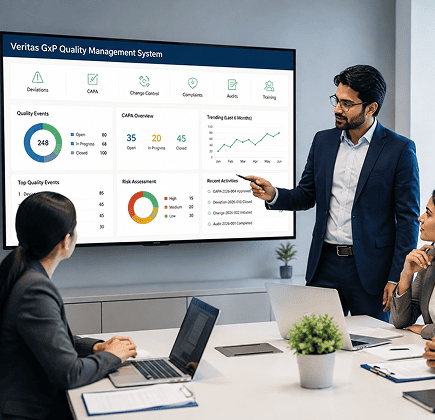
A Pharmaceutical Quality Management System (QMS) is software that centralizes and manages quality events, deviations, non-conformances, CAPA, change control, complaints, audits, risk management, training, and controlled documentation within one connected and auditable system. It helps pharmaceutical manufacturers replace disconnected spreadsheets, paper records, and manual processes with standardized workflows, complete traceability, and controlled electronic quality records.
Veritas GxP Quality Management System is designed for GMP-regulated pharmaceutical and life sciences organizations. It connects quality events with investigations, root cause analysis, risk assessments, corrective and preventive actions (CAPA), approvals, and effectiveness checks to maintain traceability throughout the complete quality record lifecycle.
By connecting quality processes with related manufacturing and compliance activities, Veritas GxP provides a centralized environment for managing quality information, approvals, electronic signatures, audit trails, and data integrity. This helps quality teams improve operational visibility, reduce manual effort, support inspection readiness, and maintain a clear history of every quality event from initiation through investigation, action, and closure.
The Real Cost of Fragmented Quality Management
Intelligent Quality Management Designed for Pharmaceutical Manufacturing
Deviation Management
Capture, classify, and investigate deviations with risk-based workflows that route the right severity to the right approver automatically — so critical deviations don't sit in the same queue as minor ones.
CAPA Management
Track corrective and preventive actions from root cause to effectiveness check, with automatic escalation when actions run overdue — so CAPAs close on evidence, not deadlines.
Change Control
Assess regulatory, operational, and quality impact before a change is approved, not after it's implemented and something breaks downstream.
Non-Conformance Management
Record and resolve product, process, material, and supplier non-conformances with full traceability back to the originating batch, lot, or supplier.
Customer Complaint Management
Link every complaint to its investigation, CAPA, and product quality review — so a pattern across three complaints gets caught, not treated as three isolated incidents.
Audit Management
Plan, execute, and close out internal, supplier, and regulatory audits with automated follow-up tracking, so findings don't get closed without action.
Supplier Quality Management
Track supplier qualifications, audits, and corrective actions in the same system as your internal quality data — so supplier risk is visible alongside your own.
Risk Management
Apply structured, configurable risk methodologies to prioritize what actually needs attention first — not just what came in first.
Training & Learning Management
Assign role-based GMP training and maintain a defensible training record for every employee — the first thing an inspector asks for.
Document Management
Version-controlled SOPs, specifications, and protocols with approval workflows — so "which version is current" is never a question anyone has to ask twice.
Investigation Management
Structured root cause analysis with evidence collection built in, so investigations produce a defensible conclusion, not just a closed ticket.
Effectiveness Checks
Verify CAPAs actually worked before closing them — catching recurrence before it becomes a pattern, not after.
Quality Event Management Workflow for Pharmaceutical Manufacturing
Record Quality Event
Capture deviations, non-conformances, complaints, or other quality events with complete batch, product, material, and process context.
Perform Risk Assessment
Assess the potential impact of the quality event on the affected pharmaceutical batch, product quality, patient safety, and compliance.
Initiate Investigation
Launch a controlled investigation and connect relevant batch records, documents, materials, processes, and supporting evidence.
Identify Root Cause
Determine the underlying cause of the event using structured investigation and root cause analysis.
Create CAPA
Define corrective and preventive actions to address the identified root cause and prevent recurrence.
Review & Approve Actions
Route proposed actions through controlled review and approval workflows with complete accountability and electronic records.
Implement Corrective Measures
Execute approved corrective and preventive actions while maintaining traceability to the original quality event and affected batch.
Perform Effectiveness Check
Verify that implemented actions have resolved the issue and effectively reduced the risk of recurrence.
Close Quality Record
Complete the investigation with a full history of the event, impact assessment, decisions, actions, approvals, and related batch information.
Monitor Quality Trends
Analyze quality events and recurring issues across batches, products, materials, processes, and manufacturing operations to identify improvement opportunities.
Fewer Fire Drills. More Inspection-Ready Days.
One Platform, Not Five
Replace disconnected spreadsheets and tools with a single validated system covering every quality process end-to-end.
Faster Closure, Not Just Faster Logging
Streamline investigation and CAPA workflows with defined ownership, due dates, escalations, evidence, and effectiveness checks.
Inspection-Ready Every Day
Reduces the time required to collect and review quality records for inspection because every record is complete, traceable, and accessible when needed.
Zero Duplicate Data Entry
One shared data model means information entered once flows everywhere it's needed — no re-keying, no mismatches.
Supplier Risk in One View
Supplier qualifications, audits, and corrective actions sit in the same dashboard as your internal quality data.
Training Compliance, Automatically
Role-based training assignments and records track themselves — no more manually chasing sign-off sheets before inspections.
Catch Patterns Early
Helps identify recurring quality issues through centralized trend visibility, not buried in a quarterly trend report nobody reads.
Real-Time Visibility, No Report-Building
Management sees live quality KPIs and overdue actions instantly, without anyone building a status deck.
Built for Global Pharmaceutical Compliance
Good Manufacturing Practice (GMP)
Standardized, documented quality processes with full process control.
21 CFR Part 11
Electronic records, electronic signatures, controlled access, and audit trail capabilities designed to support applicable 21 CFR Part 11 requirements.
EU GMP Annex 11
Controlled computerized system capabilities designed to support applicable EU GMP Annex 11 expectations, including access control, traceability, and data integrity.
ALCOA+ Data Integrity
Every record is attributable, legible, contemporaneous, original, accurate, complete, consistent, enduring, and available — by design, not by manual review.
Electronic Signatures
Controlled electronic approvals with electronic signatures on deviations, CAPAs, investigations, and change controls.
Audit Trail
System events, modifications, and approvals are captured in the audit trail to maintain a traceable record history.
Role-Based Access Control (RBAC)
Configurable permissions and segregation of duties, enforced by the system, not by policy alone.
Inspection Readiness
Complete quality documentation, generated on demand — not reconstructed under deadline pressure.
Built for the Quality Team That Actually Runs GMP Operations
Generic QMS Software Often Requires Extensive Adaptation for Pharmaceutical Workflows
Pharmaceutical quality events should never exist as isolated records. Veritas GxP connects deviations, non-conformances, investigations, CAPAs, and quality decisions to the relevant batch, product, lot, material, process, and controlled records—giving quality teams complete context throughout the quality lifecycle.
Veritas GxP is designed for pharmaceutical organizations that need connected, traceable, and configurable quality processes rather than isolated quality records.
When a quality event affects a pharmaceutical batch, teams can assess its potential impact, investigate the issue, identify the root cause, implement corrective and preventive actions, and maintain a complete history of every decision and approval.
Because the Quality Management System works within the same connected platform as Electronic Batch Manufacturing Records (eBMR), quality events and related investigations can remain associated with the relevant batch instead of being managed as disconnected records. This gives quality teams the information and traceability needed during batch review and final quality approval.
Veritas GxP is modular, allowing organizations to start with the quality capabilities they need—such as deviations and CAPA—and expand with additional modules as requirements evolve. Workflows, approval chains, and escalation rules can be configured to align with established SOPs, while deviations, CAPAs, training, and controlled documents remain connected through a shared data foundation.
A connected Pharmaceutical QMS can integrate quality events with manufacturing and compliance processes such as Electronic Batch Manufacturing Records (eBMR), batch review, document management, training, electronic signatures, audit trails, and risk management. This helps organizations maintain traceability between the original quality event, the affected batch or process, the investigation, corrective actions, approvals, and final closure.

Pharmaceutical Quality Management Software for Connected GMP Operations
See Veritas GxP QMS in Action
+91 9260246321Software that centralizes deviations, CAPA, change control, complaints, audits, training, and documentation into one compliant system — replacing spreadsheets, email approvals, and paper records.
Because inspectors don't just check whether you found a problem — they check whether you can prove, with a full audit trail, that you investigated it properly and confirmed the fix worked. A QMS makes that traceability automatic instead of something you reconstruct under deadline pressure.
Deviation management, CAPA, change control, non-conformance, complaint management, audit management, supplier quality, risk management (ICH Q9), training (LMS), document management, investigation management, and effectiveness checks — all in one platform.
Yes — they share the same underlying data model, so a deviation automatically links to its investigation, root cause, and any CAPA it generates. Nothing has to be manually cross-referenced.
Risk assessments use configurable methodologies aligned to ICH Q9 principles, so you can prioritize investigations and CAPAs by actual patient and business risk rather than by whichever ticket came in first.
Yes — every approval (deviations, CAPAs, investigations, change controls, documents) is captured with a 21 CFR Part 11-compliant e-signature, and every system event is logged in an immutable audit trail.
Yes — quality events can link directly to batch records and controlled documents, so a deviation tied to a specific batch is traceable back to the eBMR record that triggered it.
GMP, 21 CFR Part 11, EU GMP Annex 11, and ALCOA+ data integrity principles — built to hold up under FDA, MHRA, and WHO inspection.
A pharmaceutical QMS can connect quality events and investigations to the affected batch, product, material, process, and supporting records. This helps quality teams maintain complete context while investigating the issue and assessing its potential impact.
When a deviation affects a pharmaceutical batch, the event can be recorded, assessed for potential impact, investigated, linked to its root cause, and managed through corrective and preventive actions. Related decisions, actions, approvals, and supporting records remain connected to the quality history.
A pharmaceutical QMS helps quality teams evaluate how a deviation or other quality event may affect the relevant batch, product, material, process, or related manufacturing records. The impact assessment can remain connected to the investigation, root cause analysis, corrective actions, and final quality decisions.
Yes. By centralizing deviations, non-conformances, investigations, CAPAs, and other quality events, a pharmaceutical QMS can help quality teams monitor trends and identify recurring issues across batches, products, materials, processes, or manufacturing operations.