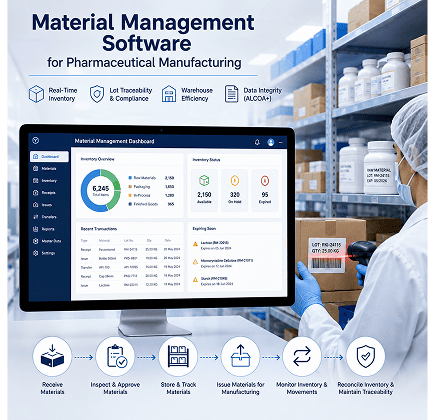
What is Pharmaceutical Material Management Software?
Material Management Software helps pharmaceutical manufacturers manage the complete lifecycle of raw materials, intermediates, packaging materials, and finished goods. It streamlines material receipt, storage, inventory control, issuance, transfers, consumption, and reconciliation while maintaining complete traceability and regulatory compliance.
By providing real-time inventory visibility, lot-level tracking, warehouse control, and integration with production planning Electronic Batch Manufacturing Records (eBMR), Material Management Software helps manufacturers identify material shortages earlier, maintain accurate inventory records, and support uninterrupted production planning.
Common Material Management Challenges in Pharmaceutical Manufacturing
Material Management Software Features for Pharmaceutical Manufacturing
Material Master Management
Centralized, version-controlled records for raw materials, intermediates, packaging materials, finished goods, and inventory classifications — so specifications and approved suppliers are never out of sync across sites.
Inventory Management
Real-time visibility into stock quantities, warehouse balances, and material movements, updated at the moment a transaction occurs — not at end-of-shift reconciliation.
Lot & Batch Traceability
Full genealogy for every material lot from receipt through dispensing, production, and reconciliation, down to which batch consumed which sub-lot — so helps users retrieve material genealogy and traceability records more efficiently.
Material Receipt & Inspection
Standardized digital workflows for receipt, quality inspection, acceptance, and rejection, with system-enforced hold states so system-enforced material status controls help prevent rejected or held lots from being issued.
Warehouse Management
Control storage locations, warehouse-to-warehouse transfers, and stock movements across multiple facilities from one dashboard, with location-level accountability for every transaction.
Material Issue & Return
Controlled, role-restricted issuance and returns with automatic quantity and expiry checks at the point of transaction — not after the fact.
Inventory Transfers
Secure, fully logged transfers between warehouses and production areas, with a complete transaction history that reconstructs itself automatically for audit purposes.
Expiry & Shelf-Life Management
Automated monitoring of expiry dates and retest periods, with proactive alerts before materials age out — so users can identify materials approaching expiry or retest dates before they become unavailable for use.
Material Reservation
Reserve materials against approved production orders ahead of time, converting "we think we have enough" into a confirmed, system-verified allocation.
Inventory Reconciliation
Automated comparison of physical inventory against electronic records, surfacing discrepancies as exceptions to review instead of requiring a full manual count to find them.
Barcode & QR Code Support
Scan-based material identification and transaction logging that reduces manual data entry during receiving, issuance, and warehouse transactions.
Real-Time Inventory Dashboard
Live visibility into stock status, availability, shortages, and warehouse performance, giving planners the ability to catch a shortfall days before it becomes a production delay.
End-to-End Pharmaceutical Material Lifecycle Management
Receive Materials
Record incoming raw materials, intermediates, packaging materials, and finished goods with supplier, lot, quantity, receipt, and inspection details.
Inspect & Approve Materials
Complete applicable receipt and quality checks, assign material status, and control materials through approved, rejected, or hold states.
Store & Track Materials
Manage warehouse locations, storage conditions, lot status, expiry or retest dates, and every material movement throughout the facility.
Issue Materials for Manufacturing
Issue approved materials against production requirements while maintaining lot-level traceability and controlled inventory transactions.
Monitor Inventory & Material Movements
Track stock availability, reservations, transfers, consumption, and inventory changes in real time across warehouses and production areas.
Reconcile Inventory & Maintain Traceability
Compare physical and electronic inventory, investigate discrepancies, and maintain complete material genealogy from receipt through manufacturing consumption.
Optimize Inventory While Ensuring Material Availability
Improve Inventory Accuracy
Real-time, transaction-level updates replace end-of-day or end-of-week reconciliation, closing the gap between physical and system inventory.
Reduce Material Shortages
Material reservation and availability checks confirm stock before a batch is scheduled — not after the line is already set up and waiting.
Strengthen Material Traceability
Full lot genealogy means a trace-back request — internal or regulatory — is a report you generate, not an investigation you conduct.
Improve Warehouse Efficiency
Barcode-driven receipt, storage, and issuance cut manual processing time and reduce the error rate that comes with re-keying data by hand.
Minimize Material Waste
Automated expiry and retest alerts catch aging stock before it becomes unusable inventory sitting on a shelf.
Faster Production Readiness
Materials are approved, reserved, and staged before batch execution begins, removing one of the most common causes of production delay.
Better Inventory Decisions
Live stock analytics give procurement and production planning a shared, accurate picture — so purchasing decisions are based on real consumption patterns, not gut estimates.
Built for GMP-Regulated Pharmaceutical Manufacturing
Good Manufacturing Practice (GMP)
Standardized, system-enforced material handling workflows replace ad hoc manual processes across receipt, storage, issuance, and disposition.
21 CFR Part 11 Support
Electronic records, controlled approvals, user access controls, and audit trails designed to support applicable 21 CFR Part 11 requirements.
EU GMP Annex 11 Support
Provides controlled access, electronic records, audit trails, and workflow controls designed to support applicable EU GMP Annex 11 requirements.
ALCOA+ Data Integrity
Material transactions are recorded with controls that support ALCOA+ data integrity principles: attributable, legible, contemporaneous, original, accurate, complete, consistent, enduring, and available records throughout the material lifecycle.
Electronic Audit Trails
Every inventory transaction, stock movement, approval, and warehouse activity is logged automatically — no manual logbook reconstruction required for an inspection.
Electronic Signatures
Secure, role-verified approvals for critical inventory transactions, material releases, and controlled warehouse activities.
Role-Based Access Control (RBAC)
Inventory functions are restricted by user role and responsibility, so access maps directly to accountability.
Complete Material Traceability
Full historical records of every material movement, from receipt through final production consumption, retrievable on demand.
Purpose-Built for Pharmaceutical Manufacturing — Not Retrofitted from Generic Inventory Software
Most inventory platforms are built for general warehousing and adapted for pharma later
— compliance features get bolted on, and traceability often stops at the SKU level rather than the individual lot. Veritas GxP is built the other way around: material management designed from the ground up around GxP data integrity , so audit trails, e-signatures, and lot genealogy aren't add-on modules — they're how the system fundamentally works.
Material Management operates within the connected Veritas GxP platform alongside Production Planning, Material Dispensing, Recipe Management, eBMR, Equipment Management, Batch Reconciliation, Quality Management. connected architecture helps material status, availability, and traceability information remain consistent across related manufacturing workflows.
Traceability that survives an audit, not just a stock count. Lot genealogy tracks materials down to the dispensing event that consumed them, so a trace-back request is a report, not a multi-day reconstruction project.
Role-based access, audit trail electronic signatures , and controlled workflows provide technical controls that complement established SOPs and quality procedures.

Need Help? Let's Talk
Talk to a GxP Expert
+91 9260246321Material Management Software helps pharmaceutical manufacturers control inventory, warehouse operations, material traceability, and inventory availability throughout manufacturing.
Effective material management prevents shortages, improves traceability, reduces inventory errors, and ensures uninterrupted GMP-compliant production.
Yes. Every material lot is tracked from receipt through storage, dispensing, production, and reconciliation, down to the individual dispensing event.
Yes. Material transactions integrate directly with Electronic Batch Manufacturing Records, so batch traceability is continuous rather than reconstructed after the fact.
Yes. Veritas GxP supports multiple warehouses, storage locations, and inventory transfers from a centralized platform.
Real-time transaction updates, barcode-based data capture, and automated reconciliation close the gap between physical and system inventory as it happens, not at month-end.
Veritas GxP Material Management supports GMP-regulated operations through controlled material workflows, electronic records, audit trails, role-based access, electronic approvals, and complete material traceability.
Warehouse, Stores, Manufacturing, Production Planning, Procurement, Supply Chain, Quality Assurance, and Inventory Control teams.
Material management in pharmaceutical manufacturing is the controlled process of receiving, inspecting, storing, issuing, transferring, consuming, and reconciling raw materials, packaging materials, intermediates, and finished goods while maintaining lot-level traceability and accurate electronic records.
Material Management links material receipts, lots, warehouse movements, issuance, consumption, and reconciliation so manufacturers can trace material history throughout the manufacturing lifecycle.
Material Management supports teams involved in pharmaceutical material control, including Warehouse and Stores, Manufacturing, Production Planning, Procurement, Supply Chain, Quality Assurance, and Inventory Control.