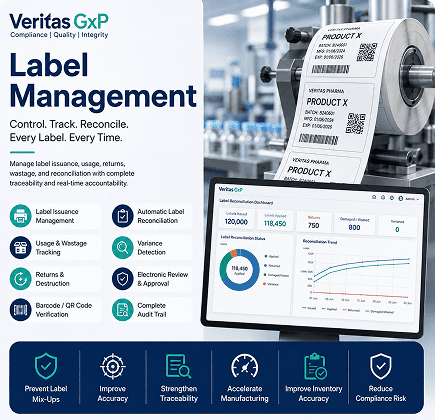
What is Label Reconciliation Software?
Label Reconciliation Software tracks the complete accountability of labels issued for a manufacturing or packaging batch — recording how many labels were issued, how many were actually applied or used, and how many were wasted, damaged, or destroyed.It continuously reconciles issued counts against used and wasted counts and flags discrepancies for review, maintaining electronic records, audit trails, and compliance with GMP, 21 CFR Part 11, EU GMP Annex 11, and ALCOA+ data integrity principles.
Why does label reconciliation matter if labels are already printed correctly? A correctly printed label is not the same as an accounted-for label. If issued labels aren't reconciled against used and wasted counts, there is no way to prove that an extra label wasn't misapplied, lost, or used on the wrong container — which can create a significant gap during labeling investigations and regulatory inspections.
Common Label Reconciliation Challenges in Pharmaceutical Manufacturing
Intelligent Label Issuance, Usage & Wastage Tracking
Label Issuance Tracking
Record the exact quantity of labels issued for every batch, container, or packaging run in real time.
Label Usage Recording
Log every label as it's applied, linking usage directly to the specific batch or container.
Label Wastage Tracking
Capture every wasted, damaged, or destroyed label with a mandatory reason code and timestamp.
Automatic Reconciliation
Automatically reconcile issued counts against used and wasted counts and flag discrepancies for review.
Reason Code Management
Standardize wastage reasons (misprint, damage, spoilage) for consistent, analyzable accountability records.
Batch-Level Accountability Reports
Generate a complete issued-used-wasted reconciliation report automatically for every batch or packaging run.
Discrepancy Alerts
Flag batches where issued counts do not reconcile before batch closure, according to configured workflow controls.
Electronic Approvals
Route unreconciled or high-wastage batches through electronic review and sign-off before release.
Role-Based Access Control
Restrict who can issue, record usage, log wastage, or approve reconciliation by user role.
Complete Audit Trails
Capture every issuance, usage entry, wastage record, and reconciliation action with full attribution.
Live Accountability Dashboard
Monitor issued, used, and wasted label counts in real time across every active batch.
Pharmaceutical Label Reconciliation Workflow
Issue Labels for Batch
Issue controlled labels against the approved batch and required packaging activities.
Record Label Usage
Record labels applied, used, returned, or remaining during batch operations.
Log Wastage with Reason Code
Record damaged, wasted, or destroyed labels with standardized reason codes.
Auto-Reconcile Counts
Record damaged, wasted, or destroyed labels with standardized reason codes.
Review Discrepancies
Identify and review label count variances before batch closure.
Approve and Close
Identify and review label count variances before batch closure.
Improve Label Accountability, Traceability, and Compliance
Reduce Unaccounted Labels
Reconcile issued labels against usage and wastage records to identify discrepancies and improve label accountability.
Improve Batch Traceability
Tie every label's fate — used or wasted — directly to a specific batch record.
Reduce Reconciliation Time
Automate issued-used-wasted counting instead of tallying paper logs by hand at batch-end.
Strengthen Regulatory Compliance
Maintain electronic reconciliation records and audit trails to support internal audits and regulatory inspections.
Improve Real-Time Visibility
See live issuance, usage, and wastage counts across every batch without waiting for batch-end.
Reduce Wastage Blind Spots
Standardized reason codes turn wastage from an unexplained loss into analyzable, trackable data.
Increase Operator Accountability
Role-based issuance and usage logging ties every label action to a specific, attributable user.
Built for GMP-Regulated Pharmaceutical Manufacturing
Good Manufacturing Practice (GMP)
Standardized issuance, usage, and wastage workflows ensure controlled label accountability across every manufacturing and packaging operation.
21 CFR Part 11
Electronic reconciliation records, approvals, and signatures provide controls designed to support applicable 21 CFR Part 11 requirements for electronic records and signatures.
EU GMP Annex 11
Provides electronic records, access controls, audit trails, and workflow controls designed to support applicable EU GMP Annex 11 expectations for computerized systems.
ALCOA+ Data Integrity Principles
Every issuance, usage, and wastage record supports ALCOA+ data integrity principles, including attributable, legible, contemporaneous, original, accurate, complete, consistent, enduring, and available records.
Electronic Signatures
Electronic approval workflows support independent review and authorization of reconciliation records before batch closure.
Electronic Audit Trails
Automatically logs every issuance, usage entry, wastage record, and reconciliation action with full user attribution.
Role-Based Access Control (RBAC)
Restricts who can issue labels, record usage, log wastage, or approve reconciliation by assigned role.
Reconciled Label Accountability Records
Maintains a controlled, matched electronic record showing issued counts against used and wasted counts for each batch.
Why Choose Veritas GxP Label Reconciliation?
A correctly designed and printed label solves one problem — accuracy at the moment of printing. It doesn't solve a different problem: proving that every single label issued to the floor was accounted for by the time the batch closed. Paper-based issuance logs and manual end-of-batch tallies leave exactly that gap open, and it's a gap that can become important during labeling investigations and regulatory inspections.
Veritas GxP Label Reconciliation is built to close that specific gap. Every issuance is logged at the moment labels leave control, every use is tied back to a batch or container, and every wasted label is captured with a reason code rather than simply discarded. The system continuously checks that issued counts equal used-plus-wasted counts — so a discrepancy surfaces in real time, not three weeks later during an audit.
Connected to Material Dispensing, Production Planning, and Electronic Batch Manufacturing Records, label accountability becomes part of the same continuous record as the rest of the batch — not a separate paper tally reconciled after the fact.

Need Help? Start Here...
Talk to a GxP Label Management Expert
+91 9260246321Label Reconciliation Software tracks how many labels are issued, used, and wasted for a batch, ensuring every issued label is fully accounted for through electronic reconciliation.
No. Veritas GxP Label Reconciliation does not create or print labels — it tracks the issuance, usage, and wastage of labels already produced, ensuring complete accountability for every label issued.
A correctly printed label can still go missing, be misapplied, or be discarded without record. Reconciliation ensures every issued label is accounted for, closing a gap that label accuracy alone doesn't address.
The system automatically flags the discrepancy and routes it for supervisor review before the batch can be closed, preventing an unexplained gap from going unnoticed.
No. Every wasted, damaged, or destroyed label requires a mandatory reason code, creating a standardized, analyzable record instead of an unexplained loss.
Yes. Issuance, usage, and wastage records are linked directly to the Electronic Batch Manufacturing Record, keeping label accountability part of the same batch record.
Every issued label is traceable to its usage or wastage record, complete with operator, reason code, and timestamp, making label accountability searchable in minutes.
The platform supports GMP, 21 CFR Part 11, EU GMP Annex 11, ALCOA+, electronic signatures, and audit trail requirements.
Label reconciliation compares the number of labels issued for a batch with the labels used and recorded as wasted or damaged, identifying discrepancies before the batch is closed.
Veritas GxP records wasted, damaged, or destroyed labels with standardized reason codes and timestamps, creating an attributable record for each wastage transaction.
Yes. The system can monitor issued, used, and wasted label quantities in real time and flag discrepancies according to configured reconciliation controls.
Veritas GxP provides controlled workflows, electronic records, audit trails, electronic approvals, role-based access, and electronic signatures designed to support applicable GMP and 21 CFR Part 11 requirements.
Yes. Label issuance, usage, and wastage records can be linked with Electronic Batch Manufacturing Records (eBMR) to maintain label accountability as part of the batch record.