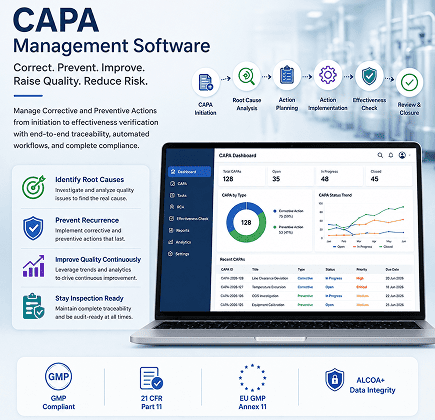
What is CAPA Management Software?
CAPA Management Software helps pharmaceutical organizations manage corrective and preventive actions arising from deviations, audits, complaints, investigations, non-conformances, supplier issues, and other quality events through a standardized electronic workflow.
Veritas GxP supports the CAPA lifecycle from initiation and root cause analysis through action planning, implementation, review, and effectiveness verification. CAPA closure can follow documented review and effectiveness verification according to the organization's configured quality workflow and procedures.
Where relevant, a CAPA can be associated with the affected deviation, batch, product, material, process, equipment, investigation, or other source quality record to maintain traceability throughout the corrective and preventive action lifecycle.
Eliminate Recurring Quality Issues With Structured CAPA Management
Intelligent CAPA Management for Pharmaceutical Quality Excellence
CAPA Initiation
Create a CAPA directly from a deviation, audit, complaint, investigation, or supplier issue — pre-linked automatically, with no manual re-entry of what triggered it.
Root Cause Analysis
Apply a structured, configurable investigation methodology so root cause is documented with evidence, not asserted from memory.
Corrective Action Planning
Define immediate corrective actions with assigned owners and target dates — so "who's doing this by when" is never ambiguous.
Preventive Action Management
Implement preventive actions that address the root cause directly, so the same deviation doesn't reopen the CAPA six months later.
Task Assignment & Tracking
Assign every CAPA activity to a named owner and track progress against due dates — visible to everyone, not just the owner.
Effectiveness Verification
Verify the corrective action actually worked through a structured effectiveness check — before closure, not after a recurrence proves it didn't.
Risk-Based Prioritization
Prioritize CAPAs by quality impact, regulatory risk, and patient safety — so the highest-risk action gets resourced first, not the oldest ticket.
Workflow Automation
Automate approvals, escalations, and review cycles, so a CAPA doesn't stall waiting on a manual reminder that never gets sent.
Electronic Review & Approval
Review and approve CAPAs with secure e-signatures and role-based access — no chasing a physical sign-off around the plant.
Dashboards & Analytics
See open CAPAs, overdue actions, and recurring issues in real time — not reconstructed for a quarterly report.
Complete Audit Trail
CAPA activities, record changes, reviews, and approvals can be captured in an audit trail to support traceability and record integrity.
Integrated Quality Management
CAPAs stay natively linked to deviations, investigations, change control, audits, and supplier quality — one record, not five systems to cross-reference by hand.
CAPA Management Workflow
Identify Quality Issue
Document the deviation, audit finding, complaint, non-conformance, or other quality event that requires corrective or preventive action.
Initiate CAPA
Create the CAPA and link it to the originating quality event, investigation, or related record to maintain complete traceability.
Perform Root Cause Analysis
Investigate the underlying cause of the issue using documented evidence and an appropriate root cause analysis methodology.
Assess Risk & Impact
Evaluate the potential impact on product quality, patient safety, affected batches, processes, materials, equipment, and GMP compliance.
Define Corrective Actions
Define actions to address the identified root cause, correct the current issue, and prevent the same problem from continuing.
Define Preventive Actions
Establish preventive actions to reduce the likelihood of similar issues occurring in other products, batches, processes, or operations.
Assign Tasks & Implement Actions
Assign responsibilities, define due dates, and track the implementation of approved corrective and preventive actions.
Review & Approve
Route CAPA actions through controlled review and approval workflows to ensure actions are properly evaluated and authorized.
Perform Effectiveness Check
Verify whether the implemented actions achieved their intended outcome and determine whether additional action is required.
Close CAPA
Complete the final review, confirm required actions and effectiveness checks are documented, and formally close the CAPA record with a complete traceable history.
Fewer Repeat Issues. CAPAs Closed on Proof, Not Deadlines.
Root Causes Fixed, Not Just Symptoms
Corrective and preventive actions address why an issue happened, helping reduce the likelihood of the same deviation or quality issue recurring.
Faster Closure
Automated workflows, notifications, and approvals help reduce manual follow-up and keep CAPA activities moving through defined review and approval stages.
Every Action Has a Named Owner
Clear responsibility and due dates on every corrective and preventive action, with no ambiguity about who's accountable.
Live Visibility Into Every CAPA
Track status, overdue actions, and effectiveness in real time — not in next month's status meeting.
One System, Every Team
Production, QA, QC, Engineering, and Regulatory work the same CAPA in the same platform, not five email threads.
Inspection-Ready by Default
Standardized records mean CAPA history is ready to present the moment an inspector asks, not reconstructed the week before.
Data Integrity Built In
Electronic signatures, audit trails, and role-based access controls support traceable and controlled CAPA record management throughout the lifecycle.
Recurring Issues Caught Early
Trend analysis helps quality teams identify recurring patterns across CAPAs and related quality events before issues become embedded in routine operations.
Built to Support Pharmaceutical Compliance
Good Manufacturing Practice (GMP)
Standardized, controlled CAPA processes with full documentation and traceability.
21 CFR Part 11
Secure electronic records, e-signatures, and audit trails for FDA-regulated environments.
EU GMP Annex 11
Support for controlled access, electronic records, auditability, and data integrity practices relevant to EU GMP Annex 11 requirements.
ALCOA+ Data Integrity
The platform is designed to support ALCOA+ data integrity principles through attributable records, controlled access, traceable changes, auditability, and appropriate record availability.
Electronic Signatures
Controlled electronic signatures can be used for defined CAPA reviews, approvals, and closure activities based on configured workflows and authorization requirements.
Audit Trail
CAPA activities, record changes, reviews, and approvals can be captured in an audit trail to support traceability and record integrity.
Role-Based Access Control
Access restricted by role, enforced by the system rather than by policy alone.
Inspection Readiness
Complete CAPA documentation generated on demand, not reconstructed under deadline pressure.
Purpose-Built for Pharmaceutical Manufacturing — Not Retrofitted from Generic CAPA Management Software
Built for Pharmaceutical Quality Teams That Run GMP Operations
Most CAPA systems are built as generic quality platforms and then adapted for pharmaceutical manufacturing. Veritas GxP is purpose-built for GMP-regulated operations, helping quality teams manage CAPAs through structured workflows, controlled reviews, approvals, traceability, and connected quality processes.
Start with the quality capabilities you need and expand as your requirements evolve. CAPA Management can connect with Deviation Management, Audit Management, Change Controland Document Management, maintain traceability across related quality activities without relying on disconnected systems.
Every workflow, approval stage, task assignment, escalation, and review process can be configured around your organization's SOPs and quality processes. CAPAs can remain connected with their originating quality event, investigation, root cause analysis, risk assessment, related changes, and effectiveness checks throughout the lifecycle.
The platform is designed to support controlled electronic signatures, audit trails, role-based access, data integrity principles, and pharmaceutical GMP workflows, helping organizations maintain inspection-ready and traceable quality records.

Request a Free Consultation.
Talk to Our GMP Software Experts
+91 9260246321CAPA Management Software helps pharmaceutical organizations manage corrective and preventive actions through structured workflows for investigation, action planning, implementation, effectiveness verification, and traceability.
CAPA provides a structured process for investigating the underlying cause of a quality issue, implementing corrective and preventive actions, and verifying whether those actions were effective.
Yes — Veritas GxP automatically links CAPAs to their originating deviation, investigation, root cause analysis, and risk assessment, with no manual cross-referencing required.
A structured effectiveness check evaluates whether the implemented actions achieved their intended outcome and whether additional action or investigation may be required.
Yes — The system supports controlled electronic signatures, audit trails, and role-based access controls for configured CAPA review, approval, and record-management activities.
Quality Assurance, Quality Control, Manufacturing, Engineering, Validation, Regulatory Affairs, and Supplier Quality teams all work CAPAs from the same system.
GMP, 21 CFR Part 11, EU GMP Annex 11, ALCOA+ data integrity, and ICH Q9 quality risk management principles.
Corrective action addresses the cause of an existing nonconformity or quality issue, while preventive action is intended to reduce the likelihood of potential issues or recurrence based on identified risks, trends, or systemic findings.
A CAPA may be initiated from deviations, non-conformances, audit findings, complaints, investigations, supplier issues, recurring quality trends, or other quality events that require structured corrective or preventive action.
CAPA effectiveness verification is a documented assessment performed after corrective or preventive actions have been implemented to evaluate whether the actions achieved their intended outcome and whether further action is required.
CAPA Management connects quality events with root cause analysis, corrective actions, preventive actions, effectiveness checks, and trend information, helping quality teams investigate systemic causes and reduce the likelihood of recurring issues.