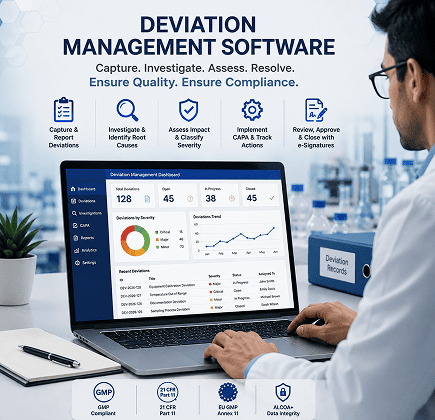
What is Deviation Management Software?
Deviation Management Software helps pharmaceutical manufacturers record, investigate, assess, approve, and resolve planned and unplanned deviations across manufacturing, packaging, laboratory, and warehouse operations — replacing manual logs and spreadsheets with a standardized electronic workflow.
Veritas GxP Deviation Management Software classifies deviations by severity, routes them through structured investigation and root cause analysis, triggers CAPA automatically when required, and captures every review and approval with a 21 CFR Part 11-compliant e-signature. It's built to hold up under FDA, MHRA, and WHO inspection — not reconstructed the week before one.
In pharmaceutical manufacturing, a deviation may be associated with a specific batch, material, process, equipment, activity, or approved procedure, making impact assessment and complete traceability essential throughout the deviation lifecycle.
Eliminate Manual Deviation Handling and Investigation Bottlenecks
Comprehensive Deviation Management for GMP-Regulated Manufacturing
Deviation Registration
Capture planned and unplanned deviations through standardized electronic forms — no more inconsistent paper formats across shifts or sites.
Criticality Classification
Classify deviations as Critical, Major, or Minor against predefined criteria based on their potential impact on product quality, patient safety, data integrity, manufacturing operations, and regulatory compliance, so the appropriate level of investigation and quality oversight can be applied.
Initial Impact Assessment
Assess the potential impact of the deviation on the affected batch, product, material, manufacturing process, product quality, patient safety, and regulatory compliance. Related batch and manufacturing information can remain connected to the deviation throughout the investigation and final quality decision.
Investigation Management
Assign investigators, set due dates, and track findings through a structured workflow — so progress doesn't depend on one person's memory.
Root Cause Analysis
Apply structured and configurable root cause analysis methodologies to investigate the underlying cause of pharmaceutical deviations using documented evidence from the affected batch, process, equipment, material, procedure, training, or other relevant records.
Risk Assessment
Evaluate deviation risk using ICH Q9-aligned principles, so the highest-risk issues get resourced first, not just the earliest-logged ones.
CAPA Integration
Automatically trigger CAPA from an investigation's findings, with full traceability back to the originating deviation.
Electronic Review & Approval
Review, approve, and close deviations with secure e-signatures and configurable approval chains — no chasing physical sign-off.
Automated Notifications
Escalate overdue investigations and pending approvals automatically, so nothing slips because a reminder email got buried.
Trend Analysis & Reporting
Spot recurring deviations and closure bottlenecks in real time, instead of discovering the pattern in a quarterly report.
Complete Audit Trail
Relevant modifications, investigation activities, reviews, and approvals are recorded in a complete audit trail to maintain a traceable history throughout the deviation lifecycle.
Integrated Quality Management
Deviations connect natively to CAPA, Change Control, Document Management, Audit Management, and Training — one record, not five systems to cross-reference.
Deviation Management Workflow
Report Deviation
Record planned or unplanned deviations and capture the affected batch, product, material, process, equipment, or manufacturing activity.
Take Immediate Action
Document immediate containment or corrective actions needed to control the issue and protect product quality while the deviation is assessed.
Classify Deviation
Classify the deviation according to predefined severity criteria to determine the required level of investigation, review, and quality oversight.
Perform Initial Impact Assessment
Evaluate the potential impact on the affected batch, product quality, patient safety, manufacturing process, and regulatory compliance.
Assign Investigation
Assign responsible investigators, due dates, and required tasks while maintaining accountability throughout the investigation.
Conduct Root Cause Analysis
Analyze available evidence to identify the underlying cause of the deviation rather than only addressing the immediate symptom.
Perform Risk Assessment
Evaluate the significance of the deviation using risk-based principles to determine the appropriate actions and level of quality oversight.
Initiate CAPA, If Required
Create and link corrective and preventive actions to address the identified root cause and reduce the risk of recurrence.
Electronic Review & Approval
Route the deviation, investigation findings, impact assessment, and required actions through controlled review and approval workflows.
Verify Effectiveness & Close Deviation
Confirm that required actions have been completed and, where applicable, verify their effectiveness before completing the deviation record and final quality closure.
Fewer Recurring Deviations. Faster, Defensible Closures.
Faster Closure, With Evidence
Automated workflows, assignments, notifications, and approvals help quality teams manage deviation investigations more efficiently while maintaining required documentation and review steps.
Consistent Investigations
Every deviation follows the same structured methodology, regardless of shift, site, or assigned investigator.
Fewer Recurring Deviations
Trend analysis and structured root cause investigations help quality teams identify process weaknesses and implement appropriate actions before recurring issues become more widespread.
Inspection-Ready Records
Complete electronic deviation records help quality teams retrieve and review supporting information more efficiently during audits and inspections.
Zero Duplicate Documentation
A connected digital workflow can reduce duplicate data entry and minimize the risk of information being lost between disconnected quality processes.
Real Cross-Functional Collaboration
Production, QA, QC, Engineering, and Regulatory investigate the same deviation in the same system, not five email threads.
Live Visibility Into Every Investigation
See deviation status, overdue tasks, and quality KPIs in real time — not in next month's status meeting.
Trends Caught Before They Repeat
Trend analysis helps quality teams identify recurring deviations and emerging patterns earlier for further investigation and improvement.
Designed to Support Pharmaceutical GMP and Data Integrity Requirements
Good Manufacturing Practice (GMP)
Standardized, controlled deviation handling with full process traceability.
21 CFR Part 11
Electronic records, electronic signatures, controlled access, and audit trail capabilities designed to support applicable 21 CFR Part 11 requirements.
EU GMP Annex 11
Computerized system capabilities designed to support applicable EU GMP Annex 11 expectations, including controlled access, traceability, and data integrity.
ALCOA+ Data Integrity
The platform includes controls designed to support ALCOA+ data integrity principles, subject to appropriate configuration, validation, procedures, and use.
Electronic Signatures
Controlled electronic signatures support traceable review and approval workflows in accordance with applicable electronic record and signature requirements.
Audit Trail
Relevant system activities, modifications, and approvals are recorded in an audit trail to maintain a traceable record history.
Role-Based Access Control (RBAC)
Access restricted by role, enforced by the system rather than by policy alone.
Inspection Readiness
Complete deviation reports generated on demand, not reconstructed under deadline pressure.
Built for the Quality Team That Actually Runs GMP Operations
Veritas GxP is designed for a modular implementation approach, allowing pharmaceutical manufacturers to start with the quality capabilities they need and expand as requirements evolve. The platform is designed around pharmaceutical GMP workflows and regulatory expectations, including those relevant to US FDA and India's CDSCO-regulated environments. Organizations can start with Deviation Management and expand with CAPA Management, Management, or Supplier Quality as their requirements evolve.
Every classification rule, investigation workflow, and approval chain can be configured to align with established SOPs. Because deviations, CAPA, training, controlled documents share a connected data foundation, a deviation can remain associated with its investigation, root cause, CAPA, related procedures, and relevant training records. This helps quality teams identify whether documentation, procedural changes, or training gaps contributed to the event.

Talk to a Deviation Management Specialist
Request a Free Consultation
+91 9260246321Software that lets pharmaceutical manufacturers electronically record, investigate, assess, approve, and close quality deviations — complete traceability and controls designed to support regulated pharmaceutical quality workflows.
Because an unresolved or poorly investigated deviation can compromise product quality, delay batch release, or become a regulatory finding —Deviation management helps pharmaceutical manufacturers ensure that quality events are documented, assessed, investigated, and managed through controlled workflows to support appropriate quality and batch-related decisions.
Both planned and unplanned deviations across manufacturing, packaging, laboratories, warehouses, engineering, utilities, and quality operations.
Yes. A deviation can be connected with investigations, root cause analysis, risk assessments, and CAPA workflows through one traceable quality record.
Through structured investigation workflows that guide quality teams to document evidence, evaluate risk, and identify a defensible root cause — not just a plausible one.
Yes —The system supports controlled electronic signatures, role-based access controls, and audit trails to maintain traceable review, approval, and record-management processes.
Quality Assurance, Quality Control, Production, Manufacturing, Engineering, Validation, and Regulatory Affairs teams all use it to manage GMP quality events from a shared system.
GMP, 21 CFR Part 11, EU GMP Annex 11, ALCOA+ data integrity, and ICH Q9 quality risk management principles.
A planned deviation is a temporary, formally assessed departure from an approved procedure that is identified and controlled before implementation. An unplanned deviation occurs unexpectedly during manufacturing, testing, packaging, warehousing, or another GMP activity and typically requires documentation, impact assessment, investigation, and appropriate corrective action.
A deviation may affect the quality, safety, identity, strength, purity, or other relevant characteristics of an associated pharmaceutical batch. Quality teams can assess the potential impact, investigate the event, document supporting evidence, and use the resulting information as part of the appropriate quality and batch review process.
A pharmaceutical deviation investigation may include the event description, affected batch or process information, immediate actions, impact assessment, supporting evidence, root cause analysis, risk assessment, corrective or preventive actions, approvals, and final closure documentation, depending on the nature and significance of the deviation.
Deviation management helps identify recurring issues by connecting deviation records, root cause findings, risk assessments, CAPAs, and trend data. Quality teams can analyze patterns across products, batches, materials, processes, or manufacturing operations and take actions to reduce the risk of recurrence.